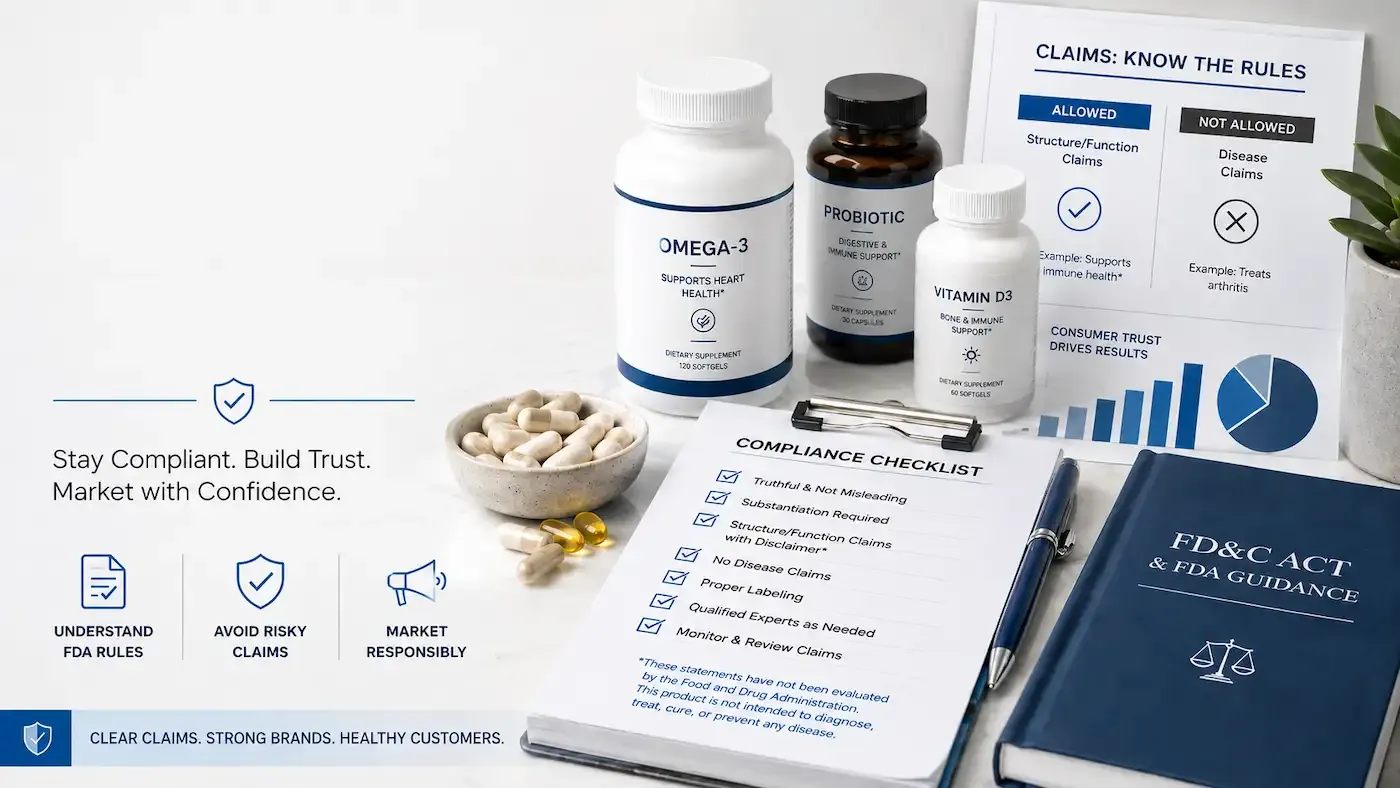
Most supplement brands don't get into regulatory trouble because they set out to break the rules. They get into trouble because the rules are genuinely confusing. This guide covers what the FDA and FTC actually allow, what language is available to you, and how to build a compliance process before copy goes live.
Most supplement brands do not get into regulatory trouble because they set out to break the rules. They get into trouble because the rules are genuinely confusing, inconsistently enforced, and written in a way that makes the wrong answer feel obvious. "Supports immune function" reads as a perfectly reasonable thing to say about your product. So does "helps with anxiety." One is fine. One is not. The difference has nothing to do with how true the claim is.
This guide covers how the FDA and FTC actually think about marketing claims for dietary supplements and regulated wellness products, what language is available to you, and what a practical compliance process looks like before copy goes live. It is written for operators and marketers, not attorneys.
- Disease claims are prohibited for supplements regardless of how good the evidence behind your ingredient is.
- Structure-function claims are the legal standard for most supplement marketing and do not require FDA pre-approval.
- The FDA disclaimer is required on every structure-function claim, on the label and in advertising.
- FTC substantiation must exist before a claim is published, not after a complaint is filed.
- Context converts acceptable claims into disease claims. What else is on your page matters as much as the claim itself.
- CBD brands face additional restrictions. The FDA has not approved hemp-derived CBD as a dietary supplement ingredient as of 2026.
- Customer testimonials are advertising under FTC rules. The 2023 Endorsement Guides apply to influencer posts, free-product reviews, and affiliate content.
What claim types are actually available to supplement brands?
The FDA draws hard lines between four categories of marketing claims for dietary supplements. Where your copy lands determines whether you need pre-authorization, what disclaimers you must include, and what your exposure looks like if enforcement happens. Most brands should operate almost entirely within one category.
Disease claims are the category that generates warning letters. The mistake most brands make is assuming a disease claim has to be explicit. It does not. The FDA evaluates claims based on the net impression a consumer would form from the full context, including the product name, the website copy, customer testimonials, blog content, and the conditions for which the product is marketed (FDA, Dietary Supplement Health and Education Act, 1994). A product named "Arthritis Relief Formula" is making a disease claim before a single word of marketing copy appears.
Health claims link a specific nutrient to a reduced risk of a specific disease. They require pre-authorization from the FDA through the formal approval process or a qualified health claim petition. The evidentiary bar is high, the process is slow, and for most supplement brands this category is practically inaccessible. Calcium and reduced risk of osteoporosis is a well-known example of an authorized health claim. Your adaptogen formula is not getting one.
Structure-function claims are where legitimate supplement marketing lives. "Supports healthy joint function." "Promotes relaxation." "Helps maintain blood sugar levels already within the normal range." "Supports immune function." These are all permissible structure-function claims. They do not require FDA pre-approval, but they require three things: the standard FDA disclaimer, notification to the FDA within 30 days of first use, and substantiation. The substantiation piece is where many brands stumble, because it is an FTC requirement, not FDA, and the standard is different.
Nutrient content claims describe the level of a nutrient in a product relative to a regulatory reference amount. "High in fiber." "Good source of vitamin D." These are governed by specific FDA definitions and percentage thresholds and carry lower risk when the nutrient levels are accurately stated on the label.
How do you tell the difference between a disease claim and a structure-function claim?
The boundary between a permissible claim and a prohibited one is not always clear from the words alone. That is what makes this category difficult for marketers. The FDA's test is not whether a claim explicitly names a disease. It is whether the net impression of the claim, in full context, implies that the product is intended to treat a disease state (FDA, 21 CFR Part 101, 2000).
Specificity is the clearest signal. Claims about normal body systems and normal function are generally permissible. Claims that name a disease, reference a disease synonym, or describe a result that only matters in the context of a disease condition are prohibited. The table below shows how that plays out across common wellness categories.
| Intended message | Disease claim (prohibited) | Structure-function alternative |
|---|---|---|
| Anxiety relief | ✗ "Reduces anxiety disorder symptoms" | ✓ "Promotes a calm, relaxed state of mind" |
| Blood sugar support | ✗ "Controls blood sugar in diabetics" | ✓ "Helps maintain blood sugar levels already within the normal range" |
| Joint health | ✗ "Treats arthritis pain" | ✓ "Supports healthy joint function and flexibility" |
| Immune support | ✗ "Prevents viral infections" | ✓ "Supports immune function" |
| Sleep | ✗ "Cures insomnia" | ✓ "Supports healthy sleep cycles" |
| Mental focus | ✗ "Treats ADHD symptoms" | ✓ "Supports mental clarity and sustained focus" |
Does hedging language help?
Not as much as brands hope. "May help fight cancer" is still a disease claim. The qualifier softens the tone but does not change the legal classification. The FDA looks at whether the overall message implies disease treatment, not whether the brand used cautious phrasing. Hedges are not shields.
The bigger risk most brands underestimate is contextual conversion. An acceptable label claim can become a de facto disease claim if it appears on a product page surrounded by testimonials from customers describing their diagnosed conditions, blog posts about specific diseases, or imagery associated with medical treatment. The FDA has made this explicit in its enforcement guidance. Context is part of the claim.
How does the FTC regulate supplement advertising, and what does substantiation actually mean?
The FDA governs labeling. The FTC governs advertising. That means the FTC covers your website, email, social media, influencer content, paid ads, and any promotional material that is not physically attached to the product. Both agencies are active in the supplement space. An FDA warning letter and an FTC enforcement action can arise from the same product, at the same time, for different violations.
The FTC's core rule is that all advertising claims must be truthful, not misleading, and backed by substantiation before the claim goes live (FTC, Health Products Compliance Guidance, 2022). For health-related supplement claims, the agency's standard typically means randomized controlled trials in humans. Animal studies and in-vitro research alone are generally not sufficient to substantiate a specific physiological claim.
The level of evidence required scales with the seriousness of the claim. A general well-being statement requires less than a claim about a specific, measurable physiological effect. Anything that uses language like "clinically proven" or "clinically tested" requires published RCTs with statistically significant results. If you are using that language without those studies, you are exposed.
| Claim type | Evidence typically required | Risk if unsubstantiated |
|---|---|---|
| General well-being | Published studies, generally accepted science | Moderate |
| Specific physiological effect | Human clinical trials preferred | Moderate to high |
| "Clinically proven" or "clinically tested" | Published RCTs with significant results | High |
| Disease risk reduction | Multiple well-designed human studies | Very high |
The FTC's 2022 Health Products Compliance Guidance is the primary reference document for current standards. It is public, detailed, and worth reading cover to cover if you are writing or approving supplement marketing copy at any scale.
What are the rules for CBD and functional mushroom brands specifically?
CBD occupies a genuinely complicated regulatory position that goes beyond the standard supplement framework. The FDA has not approved hemp-derived CBD as a dietary supplement ingredient under the Federal Food, Drug, and Cosmetic Act. The reason is procedural: CBD was first approved as a prescription drug (Epidiolex) before it entered the supplement market, and existing law does not allow an ingredient that was first approved as a drug to be marketed as a dietary supplement (FDA, Cannabis and Cannabis-Derived Compounds, 2022).
In practice, the FDA has exercised enforcement discretion for many CBD products while its regulatory framework continues to develop. Enforcement has focused on brands making disease claims, brands making unsubstantiated efficacy claims, and products positioned as treatments for serious conditions. That pattern is likely to continue, but it is not a guarantee of safety for brands operating in the gray area.
Functional mushroom and adaptogen brands are on more stable ground. Products containing reishi, lion's mane, ashwagandha, and related ingredients are generally classified as dietary supplements when properly labeled, and they can make structure-function claims under the standard DSHEA framework. The same substantiation and disclaimer requirements apply.
Regardless of ingredient, the prohibition on disease claims is uniform across every product in this category. No CBD brand, mushroom brand, or adaptogen brand can claim to diagnose, treat, cure, or prevent any disease without FDA drug approval. That line does not move.
How do you actually write compliant marketing claims, step by step?
Compliance is not a review step at the end of the copywriting process. It is a writing discipline built into the beginning of it. Brands that consistently stay out of trouble treat regulatory awareness the way they treat brand voice: as a constraint that shapes the work from the first draft, not an editor brought in to clean up at the end.
-
1
Decide your claim category before writing anything
Before you open a doc, identify what you are trying to communicate and which claim category it falls into. If the message implies disease treatment at its core, restructure the brief around a structure-function outcome instead. This decision made at the brief stage prevents multiple rounds of revision later and keeps the writing team from going down a path that cannot be salvaged.
-
2
Assemble the substantiation file before writing
Collect the published studies that support your intended claims before a word is written. FTC substantiation must exist before the claim is published. Your file should include the citation, the specific finding, the study population, and an honest assessment of whether the finding directly supports your intended claim language. A study on isolated curcumin in mice does not substantiate a claim for a multi-ingredient turmeric product in humans.
-
3
Write using structure-function language patterns
Use verbs that describe support, promotion, and maintenance of normal function: "supports," "promotes," "helps maintain," "may help," "contributes to." Avoid any verb that implies correcting a disease state: "treats," "fights," "controls," "relieves" when the condition being relieved is a recognized disease. Write with the assumption that the FDA will read your copy alongside your full website.
-
4
Add the required FDA disclaimer to every structure-function claim
The required text is: "This statement has not been evaluated by the Food and Drug Administration. This product is not intended to diagnose, treat, cure, or prevent any disease." It must appear prominently near each structure-function claim on the product label, in type no smaller than one-sixteenth of an inch. It should also appear on advertising pages where structure-function claims are made.
-
5
Audit every brand touchpoint for disease-claim context
Review your website, product pages, email sequences, social media profiles, Amazon listings, third-party retailer pages, and any influencer content connected to the brand. A disease-free label claim becomes a disease claim in context if it sits next to testimonials about diagnosed conditions, blog posts organized around disease names, or category imagery associated with medical treatment.
-
6
Submit FDA notification within 30 days of first use
For structure-function claims, brands must notify the FDA within 30 days of first marketing a product with those claims. This is not an approval process. It is a notification. Submit it to the FDA's Office of Nutritional Products, Labeling, and Dietary Supplements. Keep a dated record of the submission.
-
7
Get legal review before anything goes live
Every material piece of supplement marketing copy should be reviewed by an attorney with FDA and FTC regulatory experience before publication. The cost of a single FTC consent decree or FDA enforcement action is many times the cost of competent legal review. Document the review with a date. That record matters if enforcement ever comes.
What are the mistakes that actually trigger enforcement?
FDA and FTC warning letters follow recognizable patterns. The violations that generate enforcement are rarely novel. They are the same errors repeated by brands that either misread the rules or assumed the agencies were not watching. They are.
- Disease names in product names or headlines. "Anxiety Support Formula," "Diabetes Blend," and "Cancer Defense" are disease claims before any copy is written. The product name is evaluated as part of the claim context.
- Testimonials describing diagnosed conditions. Customer reviews saying a product helped with fibromyalgia, ADHD, or Type 2 diabetes create disease-claim context for every product claim on the page, even if the label claims are clean.
- Citing studies that do not support the specific claim. Linking to a published study does not substantiate a claim unless the findings directly support the specific language being used, in a comparable population, at a comparable dose. Referencing a study on a different form of the ingredient, at a dose not reflected in your product, does not satisfy the standard.
- Assuming Amazon listings are outside FDA jurisdiction. Third-party retail listings are considered labeling under FDA definitions if the brand controls or directs their content. Warning letters have been issued specifically for Amazon listing copy.
- Ignoring influencer content. Posts by paid influencers, including posts compensated with free product, are advertising under FTC rules. If an influencer makes a disease claim about your product without appropriate disclosure, the brand carries exposure.
How to evaluate whether your copy actually meets the standard
Before any supplement marketing claim is published, it should pass five internal checks. These are not a legal safe harbor. They are a practical framework for internal review before legal counsel sees the copy.
- Claim category confirmed in writing. Document that the claim is a structure-function claim. If there is internal debate about whether it might be a disease claim, it is a disease claim until a regulatory attorney says otherwise.
- Substantiation file complete. Published studies are on file. They are in human populations. The findings directly support the specific claim language. The dose in the study is comparable to the dose in the product.
- Disclaimer present and prominent. The FDA disclaimer appears on the label and on every advertising page where structure-function claims appear, in size and placement that meets the regulatory standard.
- Full-context review completed. Every claim has been read in the context of the full page, surrounding testimonials, product category, and nearby blog content. The cumulative impression does not imply disease treatment.
- Legal review documented. Qualified counsel reviewed the copy before publication. There is a dated record of that review.
What marketing claims can supplement brands legally make?
The available categories are structure-function claims, nutrient content claims, and general well-being statements. Structure-function claims describe how an ingredient affects normal body structure or function without referencing a specific disease. Disease claims, which imply the product treats or prevents a specific condition, require FDA drug approval and are not available to supplement brands. All structure-function claims require the standard FDA disclaimer and notification to the FDA within 30 days of first use.
What is the difference between a health claim and a structure-function claim?
A health claim links a specific nutrient to a reduced risk of a specific disease and requires FDA pre-authorization. A structure-function claim describes how an ingredient affects normal body function without referencing a disease and does not require pre-approval. For almost every supplement brand, structure-function claims are the only practical option. Health claims are available only under specific FDA-authorized conditions with substantial scientific consensus behind them, and the authorization process is lengthy.
How does the FTC regulate supplement advertising?
The FTC governs supplement advertising under Section 5 of the FTC Act, which prohibits unfair or deceptive acts in commerce. All advertising claims must be truthful, not misleading, and backed by competent and reliable scientific evidence before they are published. The FTC's 2022 Health Products Compliance Guidance is the current reference document. Enforcement can include civil penalties, injunctions, consumer redress, and required changes to advertising practices.
What triggers an FDA warning letter for supplement brands?
Disease claims on labels or websites are the most common trigger, followed by unauthorized health claims, false or misleading efficacy statements, and Good Manufacturing Practice violations. The FDA monitors brand websites, social media, Amazon listings, and physical labels. Third-party retailer pages and influencer content that brands control or direct are also within the FDA's scope as labeling.
Can I say my supplement "supports immune function"?
"Supports immune function" is a permissible structure-function claim, provided it is truthful, substantiated by scientific evidence, and accompanied by the required FDA disclaimer. You also need to notify the FDA within 30 days of first using the claim in commerce. The claim language is acceptable. The substantiation requirement means you must have published scientific evidence supporting the immune function benefit for your specific ingredient or product before the copy goes live.
Do CBD products follow the same marketing rules as supplements?
CBD brands face additional restrictions. The FDA has not approved hemp-derived CBD as a dietary supplement ingredient, because CBD was first approved as a prescription drug before entering the supplement market. This technically disqualifies it from the dietary supplement category under current law. In practice, the FDA has focused enforcement on disease claims and serious unsubstantiated efficacy claims. Operating without legal counsel in this category is a significant risk.
What counts as a disease claim in supplement marketing?
A disease claim implies that a product diagnoses, treats, cures, mitigates, or prevents a specific disease. This includes explicit statements, implied statements, disease synonyms, and contextual framing that suggests a disease state is being addressed. The FDA evaluates claims based on the net impression a consumer receives from all available information. Product name, label, website copy, testimonials, and surrounding content all factor into the evaluation.
Are customer testimonials subject to FTC rules?
Yes. The FTC's 2023 revised Endorsement Guides require that testimonials reflect typical consumer results or clearly disclose what results consumers generally achieve. Exceptional testimonials cannot be presented as representative without appropriate qualification. Any material connection between a brand and an endorser, including free product, affiliate commissions, or paid partnerships, must be clearly disclosed regardless of platform or format.
What is the required FDA disclaimer for structure-function claims?
The full required text is: "This statement has not been evaluated by the Food and Drug Administration. This product is not intended to diagnose, treat, cure, or prevent any disease." It must appear prominently on product labels near each structure-function claim, in type no smaller than one-sixteenth of an inch. It should also appear in advertising and on website pages where structure-function claims are made.
How much scientific evidence does the FTC require to substantiate a supplement claim?
The FTC requires "competent and reliable scientific evidence," which for health-related supplement claims typically means randomized controlled trials in human populations. Animal studies and in-vitro research alone are not sufficient for most physiological claims. The required level of evidence increases with the seriousness of the claimed benefit. General well-being claims can be supported by less rigorous evidence than claims about specific, measurable physiological effects.
Check your copy before it costs you.
The Bloom Division's Label Checker gives you a risk-awareness score on any draft marketing claim, based on historical FDA and FTC enforcement patterns. A first filter before legal review, not a replacement for it.
Try the Label CheckerSources
- U.S. Food and Drug Administration. "Dietary Supplement Health and Education Act of 1994." FDA. 1994. fda.gov
- U.S. Food and Drug Administration. "Statements Made for Dietary Supplements Concerning the Effect of the Product on the Structure or Function of the Body; Final Rule." 21 CFR Part 101. FDA. 2000. fda.gov
- Federal Trade Commission. "Dietary Supplements: An Advertising Guide for Industry." FTC. 2022. ftc.gov
- Federal Trade Commission. "Health Products Compliance Guidance." FTC. 2022. ftc.gov
- Federal Trade Commission. "FTC's Endorsement Guides: What People Are Asking." FTC. 2023. ftc.gov
- U.S. Food and Drug Administration. "What You Need to Know About Products Containing Cannabis or Cannabis-Derived Compounds." FDA. 2022. fda.gov
- U.S. Food and Drug Administration. "Warning Letters and Test Results for Dietary Supplements." FDA. 2026. fda.gov
- U.S. Food and Drug Administration. "Structure/Function Claims." FDA. 2024. fda.gov
- Federal Trade Commission. "FTC Act Section 5: Unfair or Deceptive Acts or Practices." FTC. 2023. ftc.gov
- U.S. Food and Drug Administration. "Overview of FDA Regulation of Dietary Supplements." FDA. 2023. fda.gov